Traditional Swedish summer farms (fäbodar) in Dalarna – a charter trip to the forest fäbods
The traditional Swedish summer farms known as fäbodar are an important part of the cultural landscape of Dalarna. Around Sälen and Västerdalarna these forest pastures tell the story of how people, animals and nature shaped life in the mountains. Here you can learn about the history of the fäbod system and discover where you can still visit living summer farms in Dalarna today.
Visiting a traditional fäbod farm is one of the most unique things to do in Sälen during the summer, where you can experience grazing cows, traditional dairy making and a living cultural landscape.
Facts: What is a fäbod?
- A fäbod is a seasonal summer farm where livestock were taken to graze.
- The tradition was common in the forest and mountain regions of Dalarna, Hälsingland and Jämtland.
- During the summer a fäbodstinta (a young woman responsible for the animals) often lived there.
- The milk was processed directly into butter, cheese and whey butter.
- The living fäbod culture was added in 2024 to UNESCO’s list of intangible cultural heritage.
The Sälen mountains in winter are a fantastic experience. Here sport and nature meet in one and the same place. But what is it like the rest of the year? Let me reassure you: Sälen is here all year round.
Something quite unique to Dalarna, Hälsingland and Jämtland is the system of summer pastures known as fäbodar. The living fäbod culture is so special that it has recently been added to UNESCO’s list of humanity’s intangible cultural heritage.
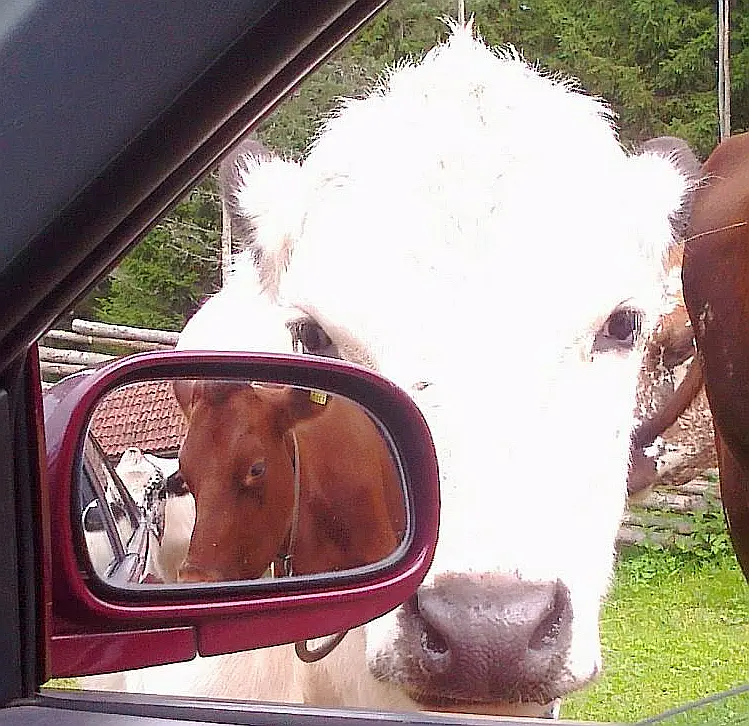
And there is something special about hearing the ground tremble as freely roaming mountain cows come down through the forest for milking. Some of them even stop curiously to inspect the car that has just arrived. A car with a cow-catcher.
Well, doesn’t this sound tempting?
But let’s start from the beginning.
The origins of the villages
Fäbodar would not exist if villages had not existed first. So where did the villages come from? No one invented villages – they simply appeared over time. No one ever thought of taking out a patent on them.
In the beginning there was only wilderness: dense forest, mosquito-ridden wetlands and the occasional mountain. Water flowed through the valleys between the mountains – small streams and larger rivers. One of them is the Västerdal River.
In some places the winding river left behind sand and gravel banks – so-called “örar” – where the soil was softer and easier to cultivate.
People also settled in places where the land could be farmed, where water was available, where there was forest for building materials and eventually transport routes. Once someone found such a promising place and built a house, it did not take long before others moved nearby. Together they could cooperate in farming, livestock management and making tools. Living close to each other also provided protection from wild predators. To ensure fairness and efficiency, the land was divided and systems were introduced where fields were periodically left fallow.
The emergence of the fäbod system
Facts: The fäbodstinta
- The fäbodstinta was the woman or girl who stayed at the summer pasture during the summer months.
- She was responsible for herding livestock and milking cows and goats.
- The milk was processed into butter, cheese and whey butter.
- She often used kulning (herding calls) or a birch-bark horn.
- The work required both knowledge and independence.
Villages grow. People move in, families have children and the need for livestock increases. Eventually the land around the village became too small to keep animals all year round. The solution was to drive cows, goats and sometimes sheep to grazing areas further away, sometimes several miles from the village.
There small seasonal settlements – fäbodar – were built where the animals could graze in the forests and mountain meadows during summer and fatten up before the often harsh winters. The fäbod belonged to the village, and the fäbodstinta was chosen because she could care for the animals, churn butter, make cheese and guard the village’s wealth.
You could say that the journey to the summer pasture and life at the fäbod was something like a charter trip – for cows, goats and the fäbodstinta. All inclusive.
The fäbodstinta called the animals using a birch-bark horn or by singing kulning. The cows were usually very motivated to return – after all, milking awaited them. The sound of kulning carries far across forests and marshes and therefore also became a way to communicate between different fäbod settlements. Perhaps it was just as well that kulning had no words. The cows understood it anyway.
But what about other two-legged listeners?
Dialects and local languages
Facts: What is kulning?
- Kulning is an old Nordic herding call.
- It is sung in very high, clear tones.
- The sound can travel several kilometres.
- It was used to call livestock home.
Music – whether the deep tones of birch-bark horns or the clear voices of kulning – is universal. Everyone understands it, unlike spoken language. In Dalarna this becomes especially clear. The differences can be large – even between neighbouring villages.
In earlier times villages were often isolated from one another. They lay in separate valleys, sometimes many kilometres apart. Over time each village therefore developed its own dialects and speech forms. One example is the Älvdalen dialect – Övdalsk – spoken in Älvdalen. It is so different that many linguists consider it a language of its own. It cannot really be said that it developed from Swedish. Rather, Swedish has changed and simplified while Övdalsk has preserved many older linguistic features.
The same applies to the Transtrand dialect spoken by the original inhabitants of the Sälen mountains. The Malung dialect can also sound almost incomprehensible to anyone not raised with it. Some members of the Andersson family still speak the Malung dialect when needed. Just ask Mats. An ä en reji dalkall.
For a long time everyone was expected to speak standard Swedish and dialects were discouraged in schools. As a result many nearly disappeared. Today attitudes have changed and local dialects can once again be taught and preserved.
Trade languages
Some languages developed locally but also within specific professions. Travelling traders from northern Dalarna – those who sold buttons and sewing accessories – spoke a secret language called knoparmoj among themselves. Knop = button, Moj = girl.
Another example is the language used by fur traders, a kind of coded speech that allowed them to talk without customers understanding. In theory they could overcharge their customers. But people in Dalarna are hardworking and honest – so nobody is being cheated here.
Fäbodar today
At one time there were up to 200 fäbod settlements in Sälen and Malung. This was when about 80 percent of the population lived from agriculture. Today that figure is below two percent.
With the arrival of milk trucks and the industrialisation of agriculture, the need for fäbodar declined and only a few remain.
Not because they are necessary anymore, but as living cultural heritage. Today visitors can experience a working fäbod in Dalarna and get a glimpse of what rural Sweden once looked like. And the opportunity to buy truly local butter and cheese is a welcome bonus.
The fäbod tradition is not just history – it is still a living part of the landscape in Dalarna.
Places where you can visit living fäbodar in Dalarna
| Fäbod | Municipality / area | Activities | Typical opening hours |
|---|---|---|---|
| Arvselen Living Summer Pasture | Malung | Living fäbod, animals, guided tours | By booking |
| Lindvallen Summer Pasture | Sälen | Animals, activities, café | Seasonal (summer) |
| Karl-Tövåsen Living Summer Pasture | Rättvik | Guided tours, traditional products | Summer weeks 28–29 Wed–Sun 12–16 |
| Prästbodarna Summer Pasture | Rättvik | Traditional environment, cabins, shop | Summer / varies |
| Ärteråsen Summer Pastures | Rättvik | Café, activities | Summer approx. 12–16 daily |
| Grejsan’s Summer Pasture | Falun / Enviken | Kulning courses, events | Summer / booking |
| Nysjön Summer Pasture | Falun | Animals, dairy products | June–August |
| Skallskog Summer Pasture | Leksand | Fäbod days, food | Summer events |
| Kättboåsen Summer Pasture | Mora | Animals, activities | Summer weekends |
| Torrlid Living Summer Pasture | Älvdalen | Traditional fäbod farming | Varies |
| Bastberget Summer Pastures | Gagnef | Cultural reserve, fäbod farming | Seasonal |
| Ljusbodarna Summer Pasture | Leksand | Traditional fäbod farming | Summer |
What about Gruven’s fäbod?
The place name still exists – not least because the local bus stop carries the name. But it has been a long time since there was an actual summer pasture there. Today several holiday accommodations stand in the area. Some visitors stay with us, and we are happy to welcome more.
In Gruven we have the very first cabin we built for rental back in 1987: the Gruven cabin, with three apartments and space for a total of 24 guests.
At our Tangen cabin in Sälfjälltangen there has never been a fäbod, but there are two apartments accommodating up to 20 guests.
If you visit Sälen in summer, take the opportunity to explore the living fäbod farms of Dalarna – it is a unique cultural experience well worth the excursion.
Welcome to Sälen – all year round.