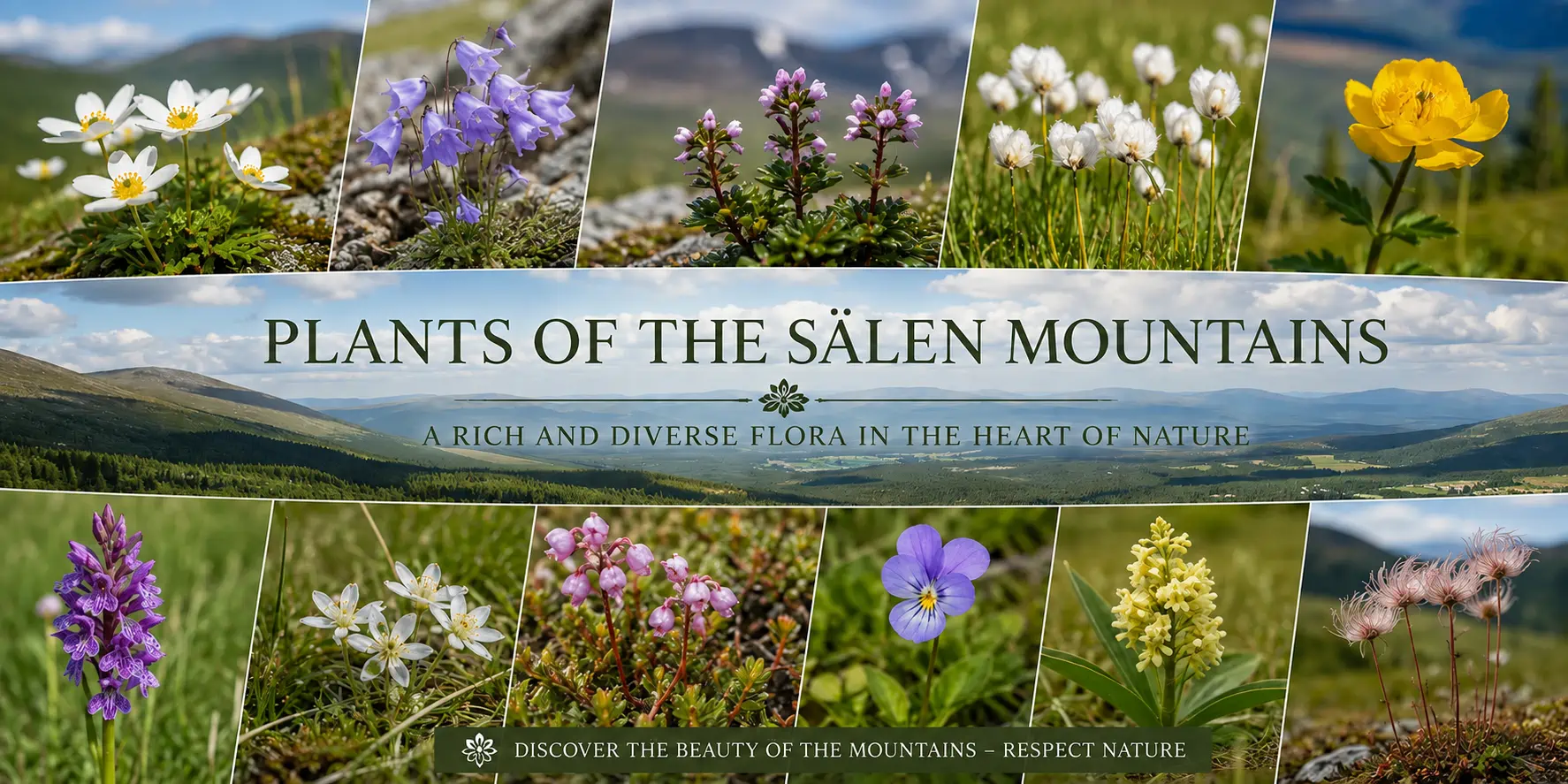
🌿 Plants of the Sälen Mountains
The Sälen Mountains have a diverse flora reflecting the area’s different natural habitats.
Here you will find coniferous forests, mountain birch woodland, mires, traditional
summer farm pastures and low-alpine heathlands. Below is a selection of plants that
have been documented in or are characteristic of the Sälen Mountains.
For several of these species, the rule is: “Look, but don’t touch.”
Learn about the Right of Public Access!!!
🌲 The Right of Public Access – in brief
The Right of Public Access gives everyone the right to enjoy
the countryside, including privately owned land, but with an obligation to
show consideration and respect for nature, wildlife and other people.
- 🚶 Walk, cycle and ski in the countryside, provided that you do not disturb or cause damage.
- 🏕️ Camp for a night or a few nights in a suitable location,
well away from houses and without disturbing the landowner. - 🍓 Pick wild berries, mushrooms and flowers that are not protected.
Special rules may apply in nature reserves and other protected areas. - 🔥 Light a fire only when it is safe and permitted.
Fires may be prohibited during periods of fire bans and in certain protected areas. - 🚫 You must not litter, damage nature, disturb residents or enter private
gardens or areas immediately surrounding homes. - 🐕 Dogs in the Sälen Mountains: Between 1 March and 20 August,
dogs must be kept on a lead or under such close control that it is equivalent
to an invisible lead. At other times, dogs may be off lead only if you have
full control and prevent them from chasing or disturbing wildlife.
In nature reserves, dogs may have to be kept on a lead all year round –
always check the local regulations.
The basic principle:
Do not disturb – do not destroy.
🌿 Please note:
In nature reserves and other protected areas in the Sälen Mountains,
special regulations may apply that restrict the Right of Public Access.
Always check the current local regulations before camping, lighting fires
or picking plants.
🌱 Dicotyledonous plants, woody plants and conifers (selected species)
| Image | Plant | Habitat & occurrence | Characteristics & flowering | Uses & harvesting |
|---|---|---|---|---|
 |
Mountain birch Betula pubescens ssp. czerepanovii |
Mountain birch woodland and mountain slopes
⭐⭐⭐ 3/5 |
May–June A low and often crooked birch with a growth form adapted to wind, snow and a short growing season. Mountain birch woodland has a relatively limited distribution in the Sälen Mountains, but occurs for example on Storfjället and Stor-Närfjället. |
🌿 Traditional use Birch sap and young leaves have traditionally been used. |
 |
Norway spruce Picea abies |
Coniferous forest, slopes and wetter woodland
⭐⭐⭐⭐⭐ 5/5 |
May–June Conifer. One of the dominant coniferous trees in the Sälen area. Recognised by its short needles and hanging cones. |
🌿 Traditional use Young spruce shoots have traditionally been used in food and beverages. |
 |
Scots pine Pinus sylvestris |
Dry and nutrient-poor coniferous forests, heaths and slopes
⭐⭐⭐⭐⭐ 5/5 |
May–June Conifer. One of the most common trees in the forests around Sälen. Recognised by the reddish upper part of the trunk and its needles growing in pairs. |
🌿 Traditional use Young shoots and other plant parts have traditionally been used. |
 |
Rowan Sorbus aucuparia |
Woodland, mountain birch woodland and open areas
⭐⭐⭐⭐ 4/5 |
June–July A small tree with white flowers and clusters of orange or red berries in late summer and autumn. |
🫐 Edible The berries usually ripen from August to October and are mainly used for jam, jelly and other preparations. |
 |
Common juniper Juniperus communis |
Dry forests, heaths and open areas
⭐⭐⭐⭐ 4/5 |
April–June An evergreen conifer with pointed needles and blue-black mature juniper berries. |
🌿 Traditional use Mature juniper berries are used as a spice. Harvesting should be limited. |
 |
Dwarf birch Betula nana |
Mountain heaths, bogs and wet areas
⭐⭐⭐ 3/5 |
May–June A low-growing birch species with small, almost round leaves. Occurs mainly on the more snow-rich mountain heaths. |
|
 |
Creeping azalea Loiseleuria procumbens |
Wind-exposed and open mountain heaths
⭐⭐⭐⭐ 4/5 |
June–July A low, creeping shrub well adapted to wind, cold and a thin snow cover. A characteristic plant of wind-exposed mountain heaths. |
|
 |
Alpine bearberry Arctous alpina |
Open and wind-exposed mountain heaths
⭐⭐⭐⭐ 4/5 |
June–July A low-growing mountain plant typical of open mountain heath vegetation dominated by crowberry. The leaves often turn a beautiful red in autumn. |
🫐 Berries The berries occur but are not normally harvested in large quantities. |
 |
Crowberry Empetrum nigrum |
Mountain heaths, bogs and nutrient-poor woodland
⭐⭐⭐⭐⭐ 5/5 |
April–June One of the most common dwarf shrubs on the open mountain heaths of the Sälen Mountains. Recognised by its small, needle-like leaves and black berries. |
🫐 Edible The berries ripen in late summer and autumn and can be used as food. |
 |
Lingonberry Vaccinium vitis-idaea |
Dry coniferous forests, heaths and mountain areas
⭐⭐⭐⭐ 4/5 |
May–June A low, evergreen dwarf shrub with white or pink flowers and red berries. In mountain environments it often grows in somewhat more sheltered locations. |
🫐 Edible Usually August–September. |
 |
Blue mountain heath Phyllodoce caerulea |
Bilberry heaths and open mountain areas
⭐⭐⭐ 3/5 |
June–July A low mountain heath with small evergreen leaves and pink to bluish, bell-shaped flowers. Part of the vegetation that can occur on the more snow-rich mountain heaths. |
|
 |
Bilberry Vaccinium myrtillus |
Coniferous forest, mountain birch woodland and mountain heaths
⭐⭐⭐⭐ 4/5 |
May–June A low-growing dwarf shrub with green, angular stems and blue berries. In mountain environments it mainly thrives in more sheltered and snow-rich locations. |
🫐 Edible Usually July–September. |
 |
Cloudberry Rubus chamaemorus |
Bogs, fens and very wet areas
⭐⭐⭐⭐ 4/5 |
June–July White flowers are followed by the characteristic orange-yellow berries. Cloudberry is a well-known plant on the bogs of the Sälen Mountains. |
🫐 Edible Usually July–August, depending on snowmelt and weather. |
 |
Bog rosemary Andromeda polifolia |
Peaty and very wet areas
⭐⭐⭐ 3/5 |
May–July A small evergreen dwarf shrub with narrow leaves and pink or white bell-shaped flowers. It has been documented on Sälfjället. |
|
 |
Creeping willow Salix repens |
Wet heaths, bog margins and open areas
⭐⭐ 2/5 |
May–June A low-growing willow that spreads close to the ground. The species is particularly interesting in Sälen because the area lies close to its northern distribution limit according to the local flora description. |
|
 |
Northern monkshood Aconitum septentrionale |
Stream ravines, damp woodland and nutrient-rich areas
⭐⭐ 2/5 |
July–August A tall herb with characteristic blue-violet, helmet-shaped flowers. A botanically interesting species because the Sälen Mountains lie near its southern distribution limit. |
☠️ Toxic The plant is poisonous. |
 |
Alpine willowherb Epilobium hornemannii |
Streams, springs, wet mountain areas and wet woodland habitats
⭐⭐ 2/5 |
July–August A low to medium-sized willowherb with pink flowers that thrives in damp environments. The species is particularly interesting because the Sälen Mountains lie near its southern distribution limit. |
|
 |
Oxeye daisy Leucanthemum vulgare |
Mountain farm meadows, hay meadows and open grasslands
⭐⭐⭐ 3/5 |
June–August A classic white meadow flower with a yellow centre. Occurs, among other places, on old mountain farm meadows where traditional management has been maintained. |
|
 |
Red campion Silene dioica |
Mountain farm meadows, hay meadows and more nutrient-rich areas
⭐⭐⭐ 3/5 |
June–August A perennial herb with pink to reddish-pink flowers. One of the species that can be found on old mountain farm meadows in the Sälen area. |
|
 |
Common sorrel Rumex acetosa |
Meadows, grasslands and wetter areas
⭐⭐⭐ 3/5 |
May–July A perennial herb with arrow-shaped leaves and small reddish flowers in a tall inflorescence. Occurs, among other places, along streams and in wetter habitats. |
🫐 Edible Young leaves can be used sparingly as a sour or tangy addition to food. |
🌾 Monocotyledonous plants (selected species)
| Image | Plant | Habitat & occurrence | Flowering & characteristics | Harvesting & use |
|---|---|---|---|---|
 |
Taiga sedge Carex norvegica ssp. inferalpina |
Wet mountain habitats, bogs and wet grasslands.
⭐⭐ 2/5 |
June–July A small sedge with narrow leaves and characteristic sedge spikes. Documented at Norra Holmen in Transtrand in 2015. |
|
 |
Long-stalked yellow-sedge Carex lepidocarpa ssp. lepidocarpa |
Rich fens and other calcareous and mineral-rich wetlands.
⭐⭐⭐ 3/5 |
June–July A sedge with characteristic beak-like fruit sacs. Documented abundantly in a rich fen approximately 500 m northwest of Hösätern in Transtrand. |
|
 |
Rusty bog-sedge Schoenus ferrugineus |
Calcareous rich fens and mineral-rich wetlands.
⭐⭐ 2/5 |
June–July A tussock-forming sedge-like plant with narrow, stiff leaves and dark to brownish spikes. Documented at Storkällan, northwest of Dragtjärnåsen in Transtrand. |
|
 |
Common cottongrass Eriophorum angustifolium |
Bogs, fens, wet meadows and other wet habitats.
⭐⭐⭐⭐⭐ 5/5 |
June–July A monocotyledonous sedge that produces white, woolly seed heads. It can occur in very large stands and make entire bogs appear white. |
|
 |
Sweet vernal grass Anthoxanthum odoratum |
Meadows, grazing land, roadsides, mountain farm meadows and open grasslands.
⭐⭐⭐⭐ 4/5 |
May–June A perennial grass that flowers early and has dense inflorescences. Recognised by its characteristic sweet scent, especially when dried as hay. Documented in the Sälen area and at several locations in Transtrand. |
Traditional hay plant. No specific harvesting is recommended from wild populations. |
 |
Creeping lady’s-tresses Goodyera repens |
Moss-rich mature coniferous forests, especially spruce forests with high humidity.
⭐⭐⭐ 3/5 |
July–August A small orchid with evergreen, net-patterned leaves and small white flowers in an upright flower spike. Red-listed as Vulnerable (VU). Documented in Transtrand. |
Protected orchid – must not be picked or dug up. |
 |
Lesser butterfly-orchid *** Platanthera bifolia |
Rich fens, wet meadows and damp woodland.
⭐⭐⭐ 3/5 |
June–July A white-flowered orchid with strongly fragrant flowers, especially in the evening. Documented in the northern Transtrand Mountains, including rich fens below the eastern slope of Öjskogsfjället. |
Protected orchid – must not be picked. |
 |
Fragrant orchid *** Gymnadenia conopsea |
Rich fens, calcareous wet habitats and herb-rich mountain meadows.
⭐⭐⭐ 3/5 |
June–August An orchid with dense inflorescences and pinkish-violet flowers. Documented in the northern Transtrand Mountains in rich fens below the eastern slope of Öjskogsfjället. |
Protected orchid – must not be picked. |
 |
Common twayblade *** Neottia ovata |
Wet meadows, herb-rich woodland and rich fens.
⭐⭐⭐ 3/5 |
June–July A green-flowered orchid with two distinctive opposite leaves. Documented in the northern Transtrand Mountains in rich fens below the eastern slope of Öjskogsfjället. |
Protected orchid – must not be picked. |
 |
Heath spotted-orchid Dactylorhiza maculata ssp. maculata |
Wet meadows, fens, bog margins and wet mountain habitats.
⭐⭐⭐ 3/5 |
June–July An orchid with spotted leaves and pink to purple flowers. Documented in the Sälen Mountains, including at Hundfjället. |
Protected orchid – must not be picked. |
Symbols:
🫐 Edible
🌿 Traditional use
☠️ Toxic
🌱 Occurrence:
⭐ 1/5 = very local or rare in the area
⭐⭐ 2/5 = uncommon
⭐⭐⭐ 3/5 = occurs at several suitable locations
⭐⭐⭐⭐ 4/5 = common
⭐⭐⭐⭐⭐ 5/5 = very common
Flowering times are approximate and may vary depending on altitude, weather,
snowmelt and the growing season in a particular year.
The Sälen Mountains are relatively low, and the bedrock is largely
low in calcium. Consequently, the mountain flora differs from that of
many higher and more calcareous mountain areas. Occurrence also varies
considerably depending on wind, snow cover, moisture, altitude and soil conditions.